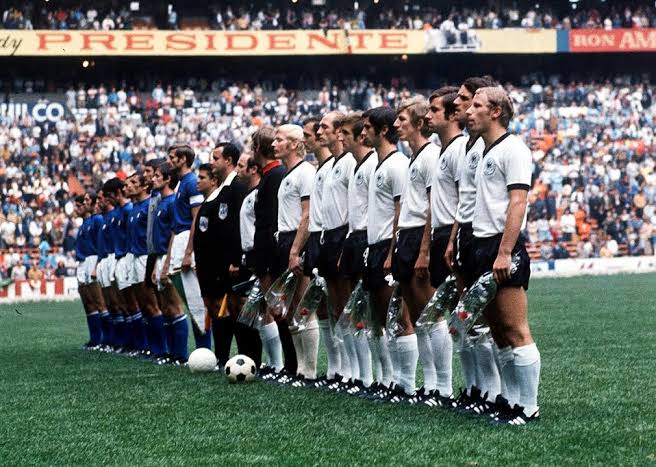
Italy’s 4–3 extra-time win over West Germany in the 1970 World Cup semi-final is remembered for its drama, but the match only earns the “Game of the Century” label when you see how a tight tactical contest gradually dissolves into a fatigue-driven, end-to-end battle. When you watch all 120 minutes, you move from a controlled Italian performance to a stretch of extra time where every attack feels like it could decide the tie, culminating in Gianni Rivera’s winner at the Azteca.
Why Italy’s early control did not guarantee safety
For most of normal time, Italy looked like the more settled side. They scored early through Roberto Boninsegna and then leaned on their defensive structure, mixing elements of catenaccio with careful possession rather than constant forward surges. With a lead to protect, they were comfortable defending deeper, denying space between the lines and asking Germany to break them down in heavy heat and altitude.
From a live-viewing standpoint, the key is how Italy manage risk after going 1–0 up. Their back line rarely over-commits, and their midfield two and sweeper focus on screening Gerd Müller and the central channels. That approach lowers the tempo and forces German attacks wide or into crowded zones, which makes it feel, for long stretches, like a classic Italian knockout performance: early goal, then control of space rather than of the ball.
How Germany’s persistence turned into the late equaliser
Despite Italy’s structure, West Germany refuse to panic. They keep circulating possession and sending controlled waves forward, relying on the work-rate of players like Franz Beckenbauer and the constant movement around Müller. As the match wears on, though, fatigue and the Azteca conditions begin to open pockets that were not there earlier, especially as Italy’s midfield legs start to fade.
The equaliser in stoppage time, scored by Karl-Heinz Schnellinger, is a reward for that persistence. Germany pile players into the box, and Italy’s defence finally fails to clear a cross properly, leaving Schnellinger free at the back post to tap in. For viewers, the deeper lesson is that repeated territorial pressure and box occupation—even against an organised defence—tend to pay off late, especially when physical and mental fatigue erode the compactness that made a lead feel safe.
Why extra time turns into a different game entirely
Once the match goes to extra time, it almost becomes a new sport. Five of the seven goals are scored in the extra 30 minutes, still a World Cup record, and the rhythm shifts from structured build-up to stretched transitions where both teams regularly attack against unbalanced defences.
The conditions are a big part of this transformation. At altitude in Mexico City and after 90 minutes of high-intensity work, both teams struggle to maintain compact lines and disciplined pressing. Gaps appear between defence and midfield, and runners break free more easily on second balls. When you rewatch this period, the main cue is how quickly both sides go from regaining the ball to playing forward within one or two passes; the priority becomes exploiting open grass, not re-establishing shape.
The extra-time goal sequence and what it teaches about momentum
Extra time delivers a sequence of dramatic swings, with each goal altering both tactics and psychology. Understanding that order helps you read the chaotic surface more clearly.
- Early in extra time, Müller puts Germany 2–1 up, capitalising on loose defending and his own sharp movement in the box. Italy’s back line, so solid for most of normal time, now looks reactive and slow to second balls.
- Italy respond quickly through Tarcisio Burgnich to make it 2–2, taking advantage of Germany’s own moment of disorganisation after finally getting in front. The goal underlines how fragile leads can be once a game’s structure has broken.
- Luigi Riva then gives Italy a 3–2 lead with a driven finish, showing that the side who best harnesses their remaining energy can flip control even after conceding first in extra time.
- Müller equalises again at 3–3, continuing his knack for finding space in crowded areas despite heavy legs on both sides. The goal is another example of how elite strikers exploit even tiny defensive lapses late on.
- Almost immediately, Rivera scores the decisive 4–3, arriving late in the box to finish a move that finds Germany mentally and physically unprepared after their own celebrations.
Seen live, these swings can feel purely emotional, but the underlying pattern is simple: every time one team surges emotionally after scoring, their structure momentarily loosens, and the opponent who keeps their head and uses the next attack efficiently tends to reply.
What you notice when you ดูบอลสด long, chaotic extra-time periods
When you ดูบอลสด a match like this, the temptation is to follow only the ball, especially once it turns into a shot-for-shot exchange. But the best way to make sense of the chaos is to keep checking line height, distances between units, and the starting positions of midfield runners each time possession turns over.
In this semi-final, extra time is defined by late arrivals into the box and defenders who cannot track every run. If you focus on who is starting their runs from deep and how many defenders are goal-side at the moment of the final pass, the goals start to look less random. Rivera’s winner, for instance, is easier to anticipate if you notice him holding slightly deeper before surging into a space vacated by German defenders dragged toward the ball.
How the goal timings frame the “Game of the Century” narrative
The distribution of goals across normal time and extra time contributes heavily to the match’s legendary status. Only two goals arrive in the first 90 minutes, while five come in the additional 30, an inversion of the normal expectation that fatigue leads to fewer clear chances. That unusual pattern is part of why the last half hour is often pointed to as “the greatest 30 minutes in World Cup history”.
Match summaries emphasise this anomaly: Italy lead from the ninth minute until stoppage time, Germany rescue the tie at 90+1, and then scoring alternates three times in extra time before Rivera finally settles it at 112 minutes. For viewers, this timeline is a reminder that “controlling” a game for long periods is not the same as closing it out; match state, substitutions, and physical resources can completely rewrite the story in the final third of the contest.
Mechanism: why extra-time chaos often favours brave runners
Mechanically, the extra-time goals show how tired defences struggle most with tracking late runners and covering far-post zones. With legs fading, defenders prioritise the ดูบอลสด changy and the nearest immediate threat, leaving space for second and third attackers arriving from deeper positions. That is why centre-forwards like Müller and late-arriving midfielders like Rivera both find decisive chances in this stretch.
For modern viewers, this mechanism is a good lens whenever a knockout tie goes beyond 90 minutes. Instead of expecting intricate patterns, watch for simple but aggressive movements: overlaps, underlaps, and delayed runs into the box that take advantage of defenders who can no longer maintain perfect orientation and awareness.
Summary
Italy vs West Germany in 1970 earns its “Game of the Century” label not just because it finished 4–3 after extra time, but because it shows, in one match, how a carefully controlled lead can evolve into one of the wildest extra-time sequences the World Cup has seen. When you watch the full 120 minutes with attention to line height, fatigue, and the timing of runs into the box, you see beyond the drama to the underlying dynamics that turned a 1–0 Italian hold into a seven-goal epic, giving you a template for reading other long, momentum-swinging knockout matches in real time.